
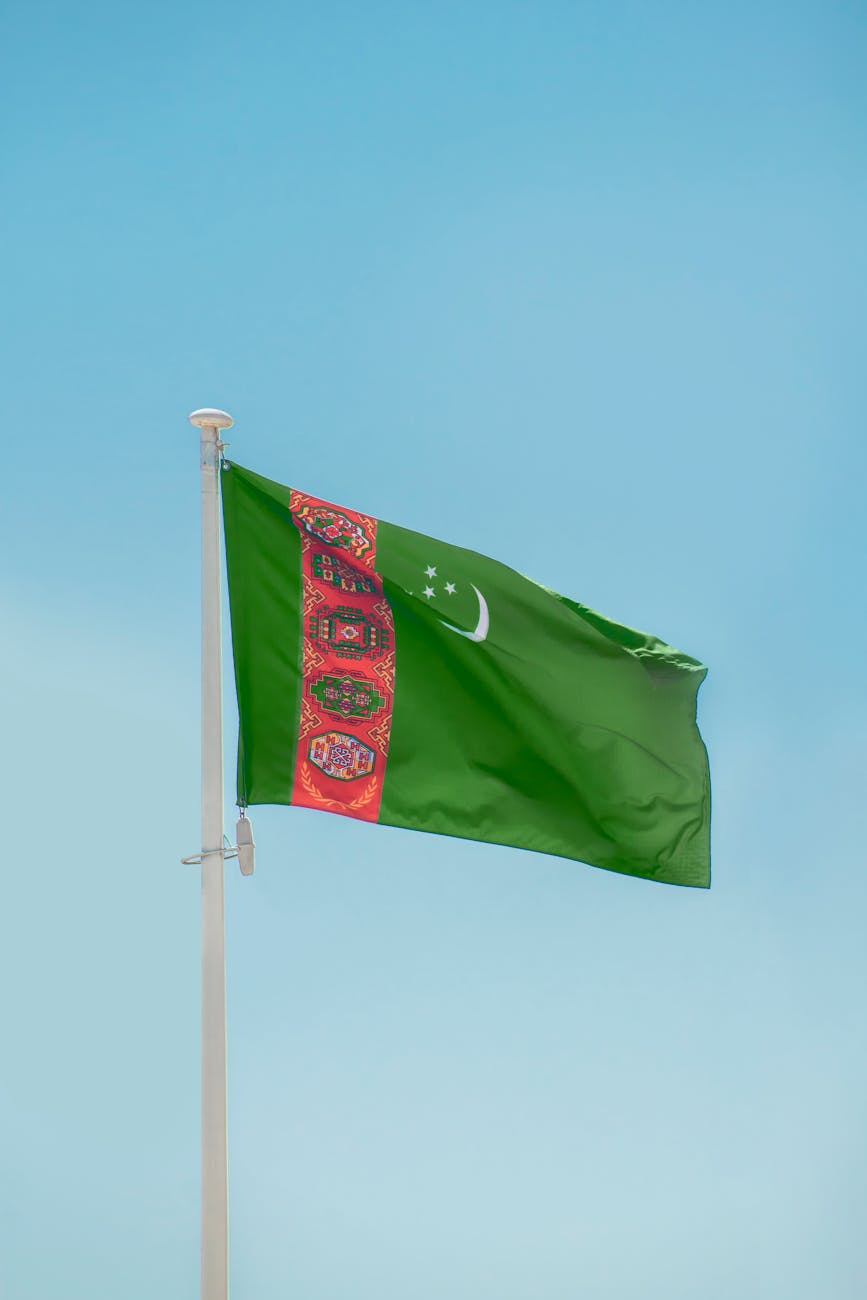
Turkmen Flag: Colors, Meaning, and History
Interpreting the Turkmen Flag: An Exploration of Turkmen Customs and Way of Life
The Turkmen flag is a vivid depiction of the people’s history, culture, and dreams, not only a symbol of their homeland. This essay explores the rich tapestry of Turkmen life by delving deeply into the meaning behind the flag’s distinguishing components and using them as a starting point. Whether you’re a culture enthusiast, a vexillology buff, or simply curious about this Central Asian nation, you’ll find valuable insights into Turkmen traditions, language, and modern society.
What Does the Turkmen Flag Look Like?
The flag of Turkmenistan features a green field with a vertical red stripe near the hoist side. Within this red stripe, you’ll find a white crescent moon and five white five-pointed stars stacked above two crossed olive branches. This striking design was adopted in 1992, shortly after Turkmenistan gained independence from the Soviet Union.
The green color dominates the flag, representing the country’s commitment to peace and neutrality. It also reflects the Islamic heritage of the Turkmen people, as green is a color of great significance in Muslim traditions. The red stripe symbolizes the progress and prosperity the nation strives for, while the crescent moon is another nod to the country’s Islamic roots.
Why Are There Five Stars on the Turkmen Flag?
The five white stars on the Turkmen flag hold deep cultural significance. They represent the five major Turkmen tribes: Teke, Yomut, Arsary, Chowdur, and Saryk. These tribes have played crucial roles in shaping Turkmen identity and history. Additionally, the stars symbolize the five regions of Turkmenistan: Ahal, Balkan, Daşoguz, Lebap, and Mary.
Interestingly, some interpretations suggest that the five stars also represent the five states of matter recognized in Turkmen tradition: earth, water, fire, air, and the fifth element, which could be interpreted as the spirit or consciousness.
How Does the Turkmen Flag Reflect Traditional Carpet Designs?
The Turkmen flag’s link to the famous carpet-making heritage of the country is among its most intriguing features. The five stars on the flag stand in for the five carpet guls, which are geometric patterns seen in Turkmen carpets. These guls are more than just ornamental pieces; they have a strong cultural significance in Turkmen culture and are frequently used as regional or tribal insignia.
Turkmen carpets, known for their intricate patterns and rich red hues, have been an integral part of nomadic life for centuries. They serve practical purposes as floor coverings and wall insulation in yurts, but they are also prized for their artistic value and as a form of cultural expression.
What Changes Has the Turkmen Flag Undergone Since Independence?
The current flag of Turkmenistan was adopted on February 19, 1992, shortly after the country gained independence from the Soviet Union. However, it has undergone a minor modification since then. In 1997, the olive branches were added to the design, symbolizing Turkmenistan’s status as a neutral country.
Prior to independence, Turkmenistan, as the Turkmen Soviet Socialist Republic, used a flag similar to those of other Soviet republics. It featured a red banner with the hammer and sickle emblem, along with a blue horizontal stripe.
How Does the Turkmen Language Reflect the Nation’s Culture?
The Turkmen language, like the flag, is a window into the culture and history of the Turkmen people. It belongs to the Turkic language family and has been influenced by Persian, Arabic, and Russian over the centuries. The language uses a modified Latin alphabet, which was adopted in 1993 to replace the Cyrillic script used during the Soviet era.
Turkmen is rich in proverbs and idioms that reflect traditional wisdom and values. Many of these sayings relate to hospitality, respect for elders, and the importance of family – all crucial aspects of Turkmen culture.
What Role Does Islam Play in Turkmen Society?
Islam is the predominant religion in Turkmenistan, and its influence is visible in many aspects of Turkmen life, including the symbolism of the national flag. The crescent moon on the flag represents the Islamic faith, while the green field is also associated with Islam.
However, it’s important to note that Turkmenistan is officially a secular state. The practice of religion is generally more moderate compared to some other predominantly Muslim countries, with a blend of Islamic traditions and pre-Islamic beliefs still evident in some customs.
How Has Turkmen Culture Evolved Since Independence?
Since gaining independence in 1991, Turkmenistan has undergone significant cultural changes. While maintaining strong ties to traditional Turkmen customs, the country has also embraced modernization. This balance is reflected in the national flag, which combines ancient symbols (like the carpet guls represented by the stars) with more modern elements (like the olive branches added in 1997).
The government has placed a strong emphasis on preserving and promoting Turkmen cultural heritage, including traditional music, dance, and crafts. At the same time, there has been a push towards technological advancement and international engagement.
What Are Some Unique Aspects of Turkmen Lifestyle?
Turkmen lifestyle is a fascinating blend of ancient traditions and modern influences. Hospitality is a cornerstone of Turkmen culture, with guests treated with the utmost respect and generosity. Traditional foods like pilaf (a rice dish) and shashlik (grilled meat skewers) remain popular, often served during festive gatherings.
The Akhal-Teke horse, known for its speed and endurance, holds a special place in Turkmen culture. These horses are featured on the state emblem and are a source of national pride.
How Is Turkmen Identity Expressed Through Art and Crafts?
Turkmen artistic expression is rich and varied, with carpet weaving being perhaps the most internationally recognized form. Each tribe has its own distinctive gul (geometric design) used in carpets, which are also represented on the national flag.
Jewelry making is another important craft, with silver being the preferred metal. Traditional Turkmen jewelry often features intricate designs and semi-precious stones.
What Challenges and Opportunities Lie Ahead for Turkmenistan?
As Turkmenistan continues to develop, it faces both challenges and opportunities. The country is rich in natural resources, particularly natural gas, which presents economic opportunities. However, diversifying the economy and adapting to global environmental concerns are ongoing challenges.
Culturally, Turkmenistan is working to preserve its unique heritage while also engaging with the global community. This balancing act is symbolized in the national flag, which combines traditional elements with symbols of peace and neutrality.
In navigating these challenges, access to information and communication across language barriers is crucial. This is where LanguageXS comes in. Our company offers convenient over-the-phone interpretation and online translation services for the Turkmen-speaking community. These services make information more accessible and foster inclusivity, helping to bridge the gap between Turkmenistan and the global community.
To sum up, here are the key points to remember about Turkmen culture, lifestyle, and language as reflected in their national flag:
-
- The Turkmen flag features a green field with a red stripe, crescent moon, stars, and olive branches, each element rich in symbolism.
-
- The five stars represent the five major Turkmen tribes and the country’s five regions.
-
- Turkmen culture is deeply influenced by its nomadic past, Islamic faith, and Soviet era history.
-
- Traditional crafts like carpet weaving and jewelry making remain important expressions of Turkmen identity.
-
- The Turkmen language, part of the Turkic family, reflects the nation’s complex history and cultural values.
-
- While embracing modernization, Turkmenistan continues to place great importance on preserving its unique cultural heritage.
FAQs: Turkmen
What languages does LanguageXS offer for Turkmen speakers?
LanguageXS provides interpretation between Turkmen and numerous other languages, including English, Russian, and Turkish.
How quickly can I access a Turkmen interpreter?
Our over-the-phone interpretation service connects you with a Turkmen interpreter within minutes, 24/7.
Can LanguageXS help with translating Turkmen documents?
Yes, we offer professional translation services for various document types, from personal to legal and technical papers.
Is the service confidential?
Absolutely. LanguageXS maintains strict confidentiality for all interpretation and translation services.
How accurate are the Turkmen translations?
Our interpreters and translators are native speakers with expertise in Turkmen culture, ensuring high accuracy and cultural sensitivity.
Can LanguageXS assist with interpreting Turkmen dialects?
Yes, our interpreters are familiar with various Turkmen dialects and can accommodate specific regional language needs.
Are there specialized Turkmen interpreters for medical or legal settings?
LanguageXS offers interpreters with expertise in various fields, including healthcare and legal sectors, to meet specific industry needs.
How does LanguageXS ensure the quality of its Turkmen language services?
We rigorously vet our interpreters and translators, and continuously monitor service quality to maintain high standards.
Can I request a specific Turkmen interpreter for ongoing projects?
Yes, for consistent long-term projects, we can arrange for you to work with the same interpreter when available.
How does pricing work for Turkmen language services?
Pricing is $20 per unit (unit=15 minutes). Also, feel free to contact us for a personalized quote tailored to your specific needs.